Wednesday, March 25, 2009

Theme


Zachary Bailey
March 25th, 2009
Blog 6
C Block

Theme: God and Divine Intervention

The theme of god and divine intervention is present all throughout the story. Even the title Their Eyes Were Watching God relates back to this theme. Throughout the entire story, the reader is bombarded with constant snippets of dialog and narrator appealing to or referring to god, and associating His involvement with events. God's presence in the story is almost that of a guide, dictating the course of the characters lives. While at first this does not seem so obvious, by the end of the story "god" seems to have stepped in and taken a direct hand in Janie's life as the whole world begins to crash down around her.

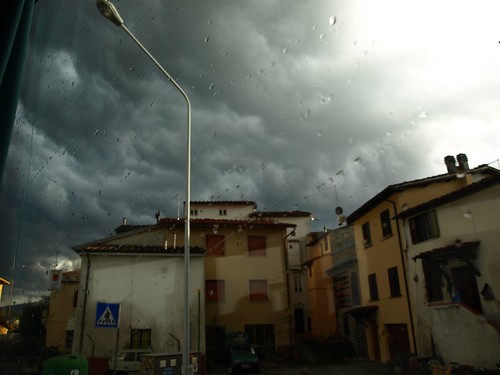
As the hurricane approaches the everglades, we see almost biblical events. The sky darkens, the winds grow ferocious, and even the animals are fleeing. Just before the true storm hits, however, the characters are roused from their games by a bolt of lightning. "Six eyes were questioning god" (page 159) and as they look out at the sky, as they looked to god, he answered "through the screaming wind they heard things crashing and things hurtling and dashing with unbelievable velocity . . . the lake got madder and madder with only its dikes between him and them" (page 159). The people that stayed, Tea Cake and Janie included, made the decision thinking that they can handle whatever is coming and effectively pitted themselves against god.

As the storm hits and everything boils over, we are witness to the destruction of the storm. During the middle of the storm, the middle of god's fury "They sat in the company with the others in other shanties, their eyes straining against crude walls and their souls asking if He meant to measure their puny might against His. They seemed to be starting into the dark, but their eyes were watching god" (page 160). They had pitted themselves against god and god pushed back and the whole world crashes down around him. By the time the eye, or at least a short respite, has reached Janie and Tea Cake they have made the decision to flee, and they leave, with the lake nipping at their heels the entire journey.

While this is not the only instance of god in the story, it represents the cumulation of His role, and for the rest of the story Janie and Tea Cake seem to be on their own, completely without god's assistance. Each situation from there on is noticeably lacking in any sort of divine interference, as if to say that, without god, the characters cannot survive. This turns out to be the case, as Tea Cake, while saving Janie from a rabid dog, is bitten. Thinking nothing of it at the time, they reach their destination and attempt to get back on their feet. In only a few weeks however, Tea Cake is dead, shot in self-defense as, in his rabies addled state, he tries to shoot her. This final moment of irony, seems to sum up the idea of the necessity of gods protection, proclaiming, through the even, that without Him they are as children, helpless.

Monday, March 23, 2009

Internal or External Conflict

Zachary Bailey
March 23rd, 2009
Post 5
Internal or External Conflict
Janie's Internal Conflict

Throughout the entire book, Janie is filled with constant inner turmoil. As a girl Janie is told by her grandmother that she is going to be married to Logan Killicks, and Janie is much less than happy about that "the vision of Logan Killicks was desecrating the pear tree, but Janie didn’t know how to tell nanny that"(page 14). Despite her feeling in the matter, Janie is married to Logan and told that she will eventually love him. A year passes however and Janie still feels nothing for him.

Eventually a strange named Jody comes along, fitting into Janie's dream of some majestic man to come sweep her off her feet. After seeing Jody for a week Janie decides to run off with him after he asks her to leave with him. For a while, things between Janie and Jody are great, and everything is all rainbows and butterflies until after a few years in Eatonville. In Eatonville, Janie is slowly crushed by Jody's ego, and the cruel way it makes him treat her. However rather then do anything about it or express her feelings, Janie "SO gradually, she pushed her teeth together and learned to hush. The spirit of the marriage left the bedroom and took to the parlor. It was there to shake hands whenever company came to visit, but it never went back to the bedroom again. So she put something there to represent the spirit like a Virgin Mary image in a church." (page 71) simply bottles everything up and learns to live with it.

Janie's entire life up to the point when she meets Tea Cake is just one big mess of inner turmoil. Despite all the things Janie dislikes or wishes were different she rarely every speaks up and never holds her ground, she just goes from one thing the next, grinning and baring it, and never standing up for herself.

Saturday, March 21, 2009

Setting & Location


Zachary Bailey
Post 4
March 21st, 2009
Setting & Location
Eatonville & The Everglades

Eatonville and the Everglades are the main locations of Their Eyes Were Watching God. Each one these places was dominated by a main character; Eatonville was the domain of Jody and The Everglades were Tea Cake's. Besides these areas being the occupying main character's place of residence, they also embodied the character that lived there.

Jody was the mayor of Eatonville. When arrived the town was nothing but 50 acres and a few people, but immediately upon arrive Jody purchases 200 additional acres, and announces his plan to build a store, establish a post office, and to bring in more people to the town. Jody turns the stunted little village into a rapidly growing and functioning town. After his initial success, he calls for an election for mayor in which he wins an immediate and undisputed victory. Jody, essentially, becomes the monarch of the town, commanding almost complete authority over the residents living there. He is the ruler of Eatonville, he walked in and paid for it, worked for it and dominated it all within a short period, and built it up as he saw fit.

South of Eatonville, out in the everglades, Tea Cake is in charge. As one of the first people to arrive at the beginning of the rice-picking season, he is one of the few people able to get a hold of a house. Come the beginning of the rice season people begin to flood into the area it is soon a rowdy, ruff-and-tumble playground. In this environment Tea Cake is king. As a career gambler, he rules supreme and there only a handful of people that can win any money off him. Everyone in town knows and loves him, and his house is always the scene of boisterous activity, full of fellow gamblers, friends, observers, and anyone looking for fun. While Jody rules because of money and power, Tea Cake rules because he commands everyone’s love and respect.

Both of these locations were an expression of the main character inhabiting it, Jody's town subdued and structured and Tea Cake's Everglades, boisterous and fun

Return with the Elixir


Zachary Bailey
Post 3
March 21st
The Hero Journey
Return with the Elixir

The Return with the Elixir actually occurs at the beginning and the end of Their Eyes Were Watching God, however, chronologically, the whole scene is at the end where it should be (We learn after getting a little ways into the story). This final step of the hero journey is embodied by Janie's return to Eatonville, after being gone for over two years. Having returned, she is back in the "ordinary world" after having been away with Tea Cake in the "Special world". Janie returns because Tea Cake dies during the Resurrection in the story and, ironically, Janie was the one who had to kill him.

Upon her return, we see the "sickness" of the town that the "elixir" will cure. Once noticed by the other towns people "she made them remember the envy they had stored up from other time" (page 2) and we see what bitterness and envy has done to them "so they chewed up the back parts of their minds and swallowed with relish. They made burning statements with questions, and killing tool out of laughs. It was mass cruelty" (page 2).

The "elixir" is simply Janie's story, her doings for the time she was gone. Only this elixir, the truth, can cure the townspeople of the animosity that they have built up over Janie's years in and out of the town. Janie finally locates her old friend Pheoby, and they both sit down, one to speak and one to listen, and Janie begins to tell her story. The book now leave "the return with the elixir" and jumps back in time to the "ordinary world", which takes place at the chronological beginning of the story. After all the other steps of the hero Journey are gone through, and one reaches the end of the book, the story returns to the elixir and the Journey and "cure" are completed.

Thursday, March 19, 2009

Characters and characterization- Jody, Janie, and Tea Cake

Zachary Bailey
Post 2
March 19th, 2009
Characters and Characterizations
Jody, Janie and Tea Cake

Their Eyes Where Watching God poses an extremely interesting twist on the normal stereotypes of characters. While Tea Cake is a Nomadic gambler, with not all that much constantly to his name, his is portrayed as the "Good Guy" of this story. Normal when one meets the stereotypical "Gambler" in any other story, they are a degenerate that a character meets and thinks is okay for a while, until it is reveled that that person is a gambler and has lost all the main character's money. This idea is very consistent, that gambler's lose, and we have seen it many time's. Look at Paul in A River Runs Through It, he was a great fun person, who is eventually beaten to death because of his gambling. Tea Cake however, defies this expansive stereotype, and turns out to be an honorable, upstanding fellow. When Janie fears that Tea Cake has taken her money and run off, not only does he return, but he promises to pay her back, and follows through "Look in mah left hand pants pocket and see whut yo' daddy brought yuh. When I tells yuh ah'm gointuh bring it, ah don't lie" (page 127). Far from being a degenerate as a gambler should be, Tea Cake is honorable and lives up to all Janie could have ever hoped of him.

Foiling Tea Cake, is Jody. Jody is the respectable hard working man, who works hard, raises to power and achieves success. Normally this character should be the "good guy" or the story, however when one gets down to it, Jody is actually somewhat of an awful person. While Jody does not commit crimes or cause anyone harm, quite the opposite in fact, that does not stop him from simply being a bad person. Jody expects the world to bend to his will, and while he basically builds Eatonville from the ground up, he appoints himself supreme leader of the town, and lords himself over everyone else. Characters in his position are normal expected to be humble, however Jody is quite the opposite. To top of his nastiness, is also just plan awful to Janie, treating her like a possession instead of a person "You gettin' too moufy Janie, Go fetch me de checker-board and de checkers." (page 75). The only good thing that Jody manages to do for Janie is die in time for her to meet Tea Cake.

Janie, the central character of the story has the weakest personality. Not to say that her actually personality is weak, but she is constantly allowing it to be covered up by the wishes of others. IN the beginning of the story Janie is a whimsical, romanticizing girl, thinking that perfect guy was going to come only and sweep her off her feet, however, at her grandmothers wishes, she stifles that and always herself to be married off. Eventually Janie lets herself show through again for awhile, when she runs off with Jody, however once she begins to get to know him and after they have been together for long enough she becomes what he wants her to be as well. "SO gradually, she pushed her teeth together and learned to hush. The spirit of the marriage left the bedroom and took to the parlor. It was there to shake hands whenever company came to visit, but it never went back to the bedroom again. So she put something there to represent the spirit like a Virgin Mary image in a church." (page 71) It is not until Janie meets Tea Cake that she at last starts to be who she truly is, and lets herself shine through.

Motif-Janie's Bandanna


Zachary Bailey
Post 1
March 19, 2009
Motif
Janie's Bandanna

IN the story, Janie's bandanna is a representation of everything stifling about her relationship with Jody. As she works in the store Jody demands that she keeps her hair tied up in a bandanna so that no one else can see or touch it. Janie however, hates keeping her hair tied up, and everything else about having to wear it the bandanna. "This business of the head-rag irked her endlessly. But Jody was set on it. Her hair was NOT going to show in the store." (page 55)

The bandanna comes to represent everything about the relationship that stifles Janie. Just like Joe won't let her wear her hair down, he won't let her do anything else that makes her happy either that could possiably make her seem in anyway equal to any of the other towns people, be it talking with the people on the porch "Janie Loved the conversation and sometimes she thought up good stories on the mule, but Joe had forbidden her to indulge" (page 53), not allowing her to go to the mule's funeral "but you ain't goin' off in all dat mess uh commonness. Ah'm surprised at yuh fuh askin'."(page 60), or any other trivial matter.

When Janie is in the store, she daydreams about being able to go sit on the porch and banter with all the other towns people, however Jody demands that she stays inside and works. Every time she does say something Jody immediately reprimands her and sends her back inside. Just as the bandanna keeps Janie's hair hidden, Jody forces Janie to keep her true self hidden, right up until the day that he dies, then, as soon as the funeral is over, "Before she slept that night she burnt up every one of her hear rags and went about the house the next morning with her hair in one thick braid swingnig below her waist." (page 89). Her freedom from the head rags, although it occures directly after his death, is synonymous with freedom from his stifling influence.

Tuesday, March 10, 2009

External and Internal Conflict

I finished this book, and after basking in the afterglow of Hurston's masterpiece, I wondered, "why is it called Their Eyes Were Watching God?"
God was mentioned, certainly, but on pure volume of content alone, religion was not the major theme in this novel. By such a standard, God has no place in the title of this book.
I would argue that the major theme of this novel is a teaching on the importance of being yourself, of individuality. Through this lens, I began to understand why God was such a large part of this novel, whether mentioned often or not.
(warning: I'm not bashing religion. Really. If you are a believer I think that is a wonderful thing; I am NOT passing judgement. These are simply generalizations about history)
Looking at the history of religion (I'm sticking to what I know- Judo-Christian religions), you can see that as we, as a society, progressed towards self-sufficiency, we became less and less religious. In the early days, when there was no such thing as science to explain death, birth, and nature, people created the idea of a God to help them to understand and explain things. Unsure of themselves and where they came from, they relied on God. Even as recent as colonial America, Calvinism and other forms of Christianity that favored an all-powerful and merciless God were popular. This was, again, during a time when people had difficult lives, unaided by modern science. They subscribed wholly to an omni-present God because they could have confidence in such a God, when they could not have confidence in themselves and their ever-changing society.
In Hurston's time there was the advent of modern electricity and other conveniences, that made it possible for people to live without difficulty, and with assurance in how the world works and, to a point, how their day to day life would be. It was this self-assurance that allowed them to be independent individuals. It also made their reliance on God less urgent; they needed God less, and so they questioned him more.
Also, black people in America were going through a dramatic coming of age. When enslaved, black people had no choice but to turn to God for hope and consistency in a life they themselves did not own. Individuality was impossible; Independence unthinkable. Upon emancipation, former slaves were thrust into a state where they could finally rely on themselves rather than God, and so they began to watch him with a careful eye.
In Their Eyes Were Watching God, a pivotal internal conflict of every character, and the psyche of black American society as a whole, is that of whether to believe in God, or believe in themselves.
The quest for individuality that is so central in this novel, is irrevocably intertwined with Hurston's constant questioning of God. Therefore, the presence of God in this novel, in the title, and more specifically, the ongoing conflict over faith, serves to further develop and enhance the main theme, which is the importance of individuality.

Monday, March 9, 2009

Author's Biographical Information

So I have been wondering about how much the novel Their Eyes Were Watching God to not just Zora Neale Hurston but all people as well. Despite being written by a black woman during the Harlem Renaissance, the novel applies to elements of transcendentalism fairly well. Transcendentalism is a universal movement, so it applies to all people and not just Hurston. The character Janie represents all people in their pursuits throughout life. Janie undergoes adversity in many ways but always manages to endure. This is similar to Hurston's own life story in which she was incessantly rebuked by her peers for being a women, but she was better then them. This ingrained in Hurston and by extension a sense to prove herself. This attribute was obvious in Hurston, but it was much more subtle in Janie. Janie yearns to be free and loved. This need pushes her through life, ever searching for her happiness and a time when she is not judged for what she is not. Janie wants to live in a world of happiness, peace, and serenity with her lover Tea Cake.

All people share that dream with Janie, they simply wish to be happy and that is what propelles them through life. Through this we can see how Janie is like any other person. Her dreams, goals, and events in life push her towards certain paths of action. If anyone were placed in Janie's shoes, especially Hurston, that person would act in the same manner as Janie. In this respect Janie can be seen as more of a universal character than just an individual. Janie underwent changes in her body, thoughts, and emotions like all other people. Following this logic Janie can be compared to everyone looking to express themselves in a world of oppression and is not just similar to Zora Neale Hurston.

Saturday, March 7, 2009

Language Appreciation& Interpretation


"The wind came back with triple fury, and put out the lights for the last time. They sat in company with the others in other shanties, their eyes straining against the crude walls and their souls asking if He meant to measure their puny might against His. They seemed to be staring at the dark, but their eyes were watching God." p. 160

Of the many noteworthy quotes in the novel, this quote stood out to me more than most, and not only because it contains the title. In this section of the story, Janie, Tea Cake, and friends are sitting in their little houses waiting out the hurricane. In this point of the novel the characters are truly frightened and facing death. What I most like about this quote is that I feel it can be applied to a lot of other moments, it is almost a universal description of real fear; the people are small and at the mercy of a higher power and can do nothing to stop it. If this quote were to stand alone the reader wouldn't know it was about a hurricane. Anyone who has ever been utterly afraid of something, not even a natural disaster but perhaps even an idea or something emotional, can relate to this. It captures the feeling of powerlessness and the darkness of something you feel you cannot prevent.

I also feel that this quote avidly represents Hurston's talent in writing. She manages to take something that could have been simply stated and makes it into nothing short of a poem. Her writing has rhythm, and her words are powerful so that they leave a mark in your mind when you read them. She is also able to accurately describe a scene without the reader feeling that she is simply describing a scene.

Thursday, March 5, 2009

Theme (Blog 6)


Many of the themes in Hurston’s novel have transcendentalist views, and one of them is: One should not go along with society’s ways and should not care what others think of them when they do something that they believe to be right. Not only does Janie go against norms and stops wearing mourning clothes, but people condemn her for going out with Tea Cake, because she had just recently lost her husband. Not to mention the fact that Tea Cake was not of her class (I mean God forbid…) When Janie’s husband, Joe Starks, dies and she starts seeing T.C., this theme begins to develop.
People are aghast that Janie would ever think to wear bright clothes when she is in the midst of grieving. The people of Eatonville judge her for it, “…dressed in blue! It was a shame. Done took to high heel slippers and a ten dollar hat! Looking like some young girl…Poor Joe Starks. Bet he turns over in his grave every day” (110). It almost sounds as if Joe Starks himself were speaking. He has had that much impact on the town that they begin thinking like him, and they judge Janie on everything that she does that Joe would be against. But Janie doesn’t care, and she’ll do what she pleases, and as she tells Phoeby, “Ah ain’t grievin’ so why do Ah hafta mourn…De world picked out black and white for mournin’, Joe didn’t. So Ah wasn’t wearin’ it for him. Ah was wearin’ it for de rest of y’all” (113), she has only grieved for Joe because the town expected her too. She was pressured into the ‘norms’ of society and she decided to break it when she dressed in blue for T.C.
Not only do the townspeople find it offensive to not wear mourning colors, they find it wrong to be seeing another man when her husband died so recently. They think things like, “Another thing, Joe Starks hadn’t been dead but nine months and here she goes sashaying off to a picnic in pink linen” (110). They think it’s too soon for her to be seeing other men…especially if it’s, “Tea Cake and Mrs. Mayor Starks! All the men that she could get, and fooling with somebody like Tea Cake!” (110), and they believe T.C. will desecrate her reputation. Just the fact that she is seeing T.C. annoys them and disgusts them. All they can think about is how T.C. is poor and how he has nothing to offer Janie, but they got it all wrong. Money has nothing to do with it. What he has to offer is love, companionship, passion, honesty, integrity, and life. That is what Janie is searching for, but their minds continue to revolve around money and they try to cajole her to stay away from him, “Dat long-legged Tea Cake ain’t got doodly squat. He ain’t got no business makin’ hissef familiar wid nobody lak you. Ah said Ah wuz goin’ to tell yuh so yuh could know” (102-103). Janie’s response to Hezekiah’s statement was, “Oh dat’s all right…thank yuh mighty much” (103), and she ends it there. She will hear all they have to say, but she will not follow any of their advice or agree with any of their opinions. She does what she wants and goes out with T.C. People say things such as, “You better sense her intuh things then ‘cause Tea Cake can’t do nothin’ but help her spend whut she got” (111), and “De men wuz talkin’ ‘bout it de grove tuhday and givin’ her and Tea Cake both de devil” (111). The are so against Janie being with T.C., but she ends up marrying him anyways (girl power!) and she says to Phoeby, “…Tea Cake ain’t draggin’ me off no where Ah don’t want tuh go. Ah always did want tuh git round uh whole heap…” (112). Besides the fact that Janie doesn’t care about T.C.’s wealth, she is following her heart and doing what SHE wants to do and not what anybody else tells her. She was told by Nanny to marry Logan Killicks and she did. She was ordered around by Joe Starks for twenty miserable years and she did what he asked. And now? She is doing what SHE wants, and she marries T.C. Now that’s what I call transcendentalist. You go Jay & T.C.

Theme: An Aspect of Transcendentalism


Throughout the novel, Janie is constantly at odds with society's expectations. At first, society is represented by Nanny. She represents society's misconception that a woman's future is in the hands of fate. She hopes Janie will "land on soft ground," as if waiting to do so is the only option. Janie submits to her grandmother's authority, and marries Logan Killicks. Janie has just given in to the expectations of society, and as a result of her capitulation, she is unhappy. Had she been true to herself, she would have refused to marry a stump and been much happier.

Another example of lack of self truth leading to unhappiness is how long Janie stays with Joe. She realizes she does not like the way Joe treats her long before she does anything about it. When she finally does, it has been twenty years and Joe is on his deathbed. Twenty years of staying in her "woman's sphere", which we know Janie doesn't like from her comments about how Joe treats her in the store and how he denies her the right to speak in public. Had Janie been true to herself and not submitted to his expectations, she would not have suffered for twenty years.

After Joe dies, Janie begins seeing Tea Cake, and people are shocked at her behavior. She is expected to be mourning her loss and wearing black. But this time Janie doesn't care what other people think. She wears the flamboyant dresses Tea Cake buys her, and goes out with him all the time. For Janie, this is fulfilling. Why? Because she is being true to herself, which always brings fulfillment and happiness.

So there you have it. The transcendentalist aspect of being true to yourself is in Their Eyes Were Watching God. Not that I think Hurston did it on purpose...

Reaction to Peer Post: Annie


After reading Annie's post on a potential theme for the novel, I wanted to support her ideas on fate since she appeared to be somewhat undecided. Death plays a major role in this novel what with the death of Nanny, the mule, Joe, and Tea Cake. Janie's character is affected by each death and she continues to discover more of her indivduality. To expand upon Annie's comment about how "death will come when it is supposed to" I would like to add something about how there is a finality to death, and yet within the novel those who are dead appear to live on for Janie. This connects directly to the idea of fate because the fact the dead are, to some extent, living for Janie eludes to the possibility of a higher power, or fate. The novel also is deeply steeped with divinity and conflicts and illusions to God or the biblical world. One such example is simply within the title, "Their Eyes Were Watching God." This title is connected to the quote that, "...their eyes straining against crude walls and their souls asking if He meant to measure their puny might against His. They seemed to be staring at the dark, but their eyes were watching God" (160). This scene occurs when Janie and Tea Cake are in the midst of the hurricane. All that Janie can do is to give herself up to nature and believe in fate itself, the idea that whatever happens will happen and she can not do anything about her circumstances or to change events that will take place. This is a direct illusion to Janie's belief in fate and the fact that fate has played a large role in the actions that she takes. Janie is a free spirited woman who is led by her whims and emotions; essentially she is led by a belief in fate.

I disagree with Annie about the innevitability of fate in that I believe that Janie's fate is inevitable because of the kind of character that she is. Janie is led by her emotions to enter into a relationship with Joe, it is not fate but her actions that lead her to flirt and draw his attention but it is Janie's fate in how her relationship ends. Janie could not perceive Joe's true character and therefore did not have control over his treatment of her. Janie yearns for love, so it is her fate that drives her to enter into numerous relationships because she continues to ceaselessly search for love and her independent freedom.

Fate also plays a large role with Janie's relationship with Tea Cake. Janie finds her true love, and yet she cannot control Fate's power to take people away. Janie's fate is to find everlasting love, no matter whether the person continues to live or not, therefore Tea Cake's death is fitting for her character.


I agree with Annie that fate plays a major role within this novel, although as for the uncertainty and inevitability I believe that there is evidence to the fact the Janie's fate was due to her type of character and personality.

Wednesday, March 4, 2009

Theme of spirituality/ religion


Earlier, Joanna said that God was an image frequently used in the book as a guiding light for the characters. I agree, and when I was reading the book, I also did not realize the importance of religion and spirituality in the book until I got to the chapters involving the storm. Even though the title is Their Eyes were Watching GOD, I forgot to look for the symbols showing the presence of a God (since the symbolism and theme of religion was not blazoned ) until I got to the line: "They seemed to be staring at the dark, but their eyes were watching God" on page 160.
The topic of religion was brought up in class today as a theme. I thought that made sense, since it was singled out as the title.
In the book, Hurston uses God as a decider of fate. God has the power to crush Janie's home and to send her fleeing. Janie, Tea Cake, and the rest of the characters are at the mercy of God, showing that Hurston believes that there are more powerful things in the universe that control them. And people should never forget that. Even though human beings such as Joe originally flaunted their power and control over other humans by throwing out God's name in the phrase, "I god!", they can never be forever in control. Instead, God will eventually remind them who is boss when he brings out nature's forces against the humans: "They sat in company with the others in other shanties, their eyes straining against crude walls and their souls, asking if He meant to measure their puny might against His" (160).
The theme that there are more powerful things that control people's lives, and that fate is settled by these powerful forces is expressed in the famous line: "They seemed to be staring at the dark, but their eyes were watching God." Janie and the others know that fate is a thing they cannot avoid. Humans are not strong enough to stop themselves from encountering fate, and in this quote they learn that they must accept life as it happens. Events such as natural disasters are reminders from God that the humans' lives are determined by Him, and only he can save them, and bring them back to the light. Even in the darkest hour when they seem to see nothing by darkness and despair, they must trust God. This shows Hurston's devout belief in spirituality and the existence of fate.

Reation to Peer Post: Barbara's Hero Journey One


I am reacting to Barbara's Hero Journey post and disagreeing with her and Krissy. I do not feel that Tea Cake is a hero/protagonist in the story and that Janie is the sole protagonist and the story is about her hero journey. My interpretation of a hero, in the sense of the monomyth, is the character who changes and learns something to better themselves throughout the novel. Tea Cake, though a major supporting character, does not change significantly thoughout the novel or better himself. From the begining Tea Cake loves Janie and is supportive of her so him dieing for her love did not change him because had already loved her. Janie on the other, does go through a big change and ultimately learns about herself by going through it. Her goal in live is to not be supressed, but also to be loved. Both of which she gains from Tea Cake. With Joe dieing, and her moving on from him to Tea Cake, she becomes englightened and fufilled. Her and Tea Cake's loving relationship is the ultimate product of her Hero Journey.

Symbols and Imagery- The Hurricane


The hurricane scene in the novel symbolizes the arbitrary nature of God, and how he is indiscriminate in who he kills or saves. Hurston notes of the refugees that "their souls [asked] if He meant to measure their puny might against His."(160), so right from the outset Hurston makes it clear that the nature of the hurricane is meant to reflect God. In the midst of the hurrican, Janie sees "people trying to run in raging waters and screaming when they found they couldn't"(161). These are people who would be killed by the hurricane whether or not they were good, law abiding citizens or not. They were merely caught in the wrong place at the wrong time, and would meet their doom in the impending lake.
However, Motor Boat ignores Tea Cake's warnings to run and instead decides to sleep in, not fully comprehending the danger he's in: "Tea Cake, Ah got tuh have mah sleep. Definitely."(164) He does not seem to have his priorities straight, yet by the end of the hurricane we find out that Motor Boat is left unscathed, since the house he was in simply floated away while he slept. To put it simply, he got lucky. This man, who didn't have the common sense to run away from an impending hurricane survived, yet many who tried to run for their lives died in the effort. This is an example of tragic irony, one that is comical yet unfair at the same time.
Tea Cake's encounter with the dog also serves as an example of indiscriminate death. Tea Cake jumped into the water to save Janie's life from the rabid dog, yet was not rewarded. To the contrary, he unwittingly contracted rabies and dies later on. The event is left as a question to the reader: what if he hadn't saved Janie? Instead of being punished for leaving her to die, it now seems as if Tea Cake would have been given the reward of life. This echoes the earlier conclusion by Janie, that the followers of God will accept anything if it means keeping the relationship: "It was inevitable that [Mrs. Turner] should accept any inconsistency and cruelty from her deity as all good worshippers do from theirs"(145). Thus, the hurricane is Janie's conclusion in action, that there is no system of reward or punishment. People die regardless of how good or bad they are.

Reaction to Lilly's Post about Conflict

Though I can agree that Janie and Tea Cake don't always act as society expects them to, I must respectfully disagree as I believe this is too underdeveloped to be a conflict. Janie and Tea Cake are exposed to two reals of society: that of Eatonville and that of the Everglades. Whereas the townsfolk of Eatonville may make suppositions about the pair, Janie and Tea Cake like in their own separate world. They are extremely adept and shutting out society, because Janie leaves for Jacksonville without a moment's notice. Though in Chapter 12, Phoebe talks to Janie about their relationship, Janie does not give a budge. This shows that Janie really isn't conflicted with society. Society simply does not approve of her, and she does not give a rat's rear-end. Because Janie and Tea Cake does not even consider the Eatonville society when making their decisions, the society's scorn is only one-way, and this does not constitute a "conflict". According to the Merriam-Webster dictionary, conflict is defined as " a: competitive or opposing action of incompatibles : antagonistic state or action (as of divergent ideas, interests, or persons) b: mental struggle resulting from incompatible or opposing needs, drives, wishes, or external or internal demands" or "the opposition of persons or forces that gives rise to the dramatic action in a drama or fiction" (I took definitions 2 and 3 because definition 1, "fight, battle, war", would make even less sense). Going down the words used in the definition: Janie and Tea Cake do not take "opposing action" against or "antagonize" with society; they do not even bat an eyelash. They do not have any "mental struggle" with society; again, they never gave any thought as to what society said about them. Tea Cake/Janie and society are not "opposing forces"; while society may put pressure on the couple, the couple does not present any force against society.

As for the society at the muck, they are not even against the Tea Cake-Janie relationship. Mrs. Turner is one woman; she does not represent all of society. In fact, the society that they are exposed to approve of their relationship. In the beginning of chapter 20, the society "begged Janie to stay on with them" (191). Though they did condemn her in the beginning, this was not prolonged to any extent to constitute a conflict. Janie simply "sent Sop word and to all the others through him. So the day of the funeral they came with shame and apology in their faces" (189). The jury aquitted her and the community forgave her for killing Tea Cake and wanted her back into their community. This shows they did not disapprove of their relationship.

Furthermore, Janie shooting Tea Cake does result in their (physical) separation, but it does not seem that "society won this battle". Society does not cause Janie to shoot Tea Cake; rather, I suppose the rabid dog could be culpable.

I do agree, however, that Janie and Tea Cake will always "be together" spiritually, as I think he was such an intense chapter in her life that she can never truly move on.

Theme: Self-Honesty/Realization


Throughout the novel, the theme of self-honesty appears many times, especially in parts where Janie is faced with challenges about love, conflicts with her feelings, and what her partners think. In the beginning of the novel Nanny forces Janie to try to be something she is not. In this instant Janie is too young to realize that she is choosing to be someone other then herself, and it takes a little while with Logan to realize this. When Janie realizes she is not being honest to herself and who she wants to be, she begins to doubt her relationship with Logan and almost looks for a way out. Luckily for her Joe Starks makes his entrance to the novel here, and he presents Janie with not only a way out, but a way out that would make her happy. Janie realizes that being true to herself was more important than her husband Logan, and she decides to run off with Joe Starks and move on to something she thought was what she wanted. Unfortunately for Janie, Joe Starks proves to be even more controlling of Janie, and I think the only reason why Janie stays is because running away did not work the first time, so she might believe that if she runs away from it this time, she will not be any better off. Janie ends up forcing herself to be a person she never wanted to be, and locks all of her true qualities away to let Joe Starks be the husband he wants to be and make her be the wife he wants her to be.
When Joe dies, Janie for the first time since her early adult hood has the ability to be the woman she wants to be. She starts talking to the men of the town and speaks her mind and does what she wants to do. When she first meets Tea Cake she is hesitant to move on, but eventually overcomes her fears. Even when the town thinks she is making a mistake, Janie stays true to her heart because of all the lessons she has learned since her childhood about being honest to your self and what you want and realizing your life is yours and you should live it to your full potential.

Reaction to a Peer Post: The Return


In Noah's blog posted yesterday, entitled "Hero Journey: The Return...Or Maybe Not," he brings up several good points supporting the idea that Janie's return to Eatonville is in fact her Return in terms of the Hero Journey. While the post addresses many good ideas, there are a couple points I'd like to add.

First, I disagree with his statement of Janie's journey. Yes, Janie certainly searches for love in her life, but I believe that her main journey is one of self- discovery, as we addressed in class today. Noah mentions her call to adventure being the awkward moment under the pear tree. In this moment, she does discover her sexuality and her want for love, but in turn, I believe she is also discovering herself and the person she wants to be. Hurston describes: "She had glossy leaves and bursting buds and she wanted to struggle with life but it seemed to elude her. Where were the singing bees for her? Nothing on the place nor in her grandma's house answered her. She searched as much of the world as she could from the top of the front steps and then went on down to the front gate and leaned over to gaze up and down the road. Looking, waiting, breathing short with impatience. Waiting for the world to be made"(11). One could argue that she is waiting for her world to be made, so in turn, she is waiting to begin a fulfilling life as an individual. She even begins searching for herself right here in this moment, as she physically looks through the house and out the gate. Since her Call to Adventure can be seen as a general call to finding her true self, the rest of her journey must follow suit. Certainly her "love story" is a large part of this journey, as it is a part of herself, but I feel her journey is a more general path to self- discovery rather than her search for love.

I do agree with Noah's description of the Return, as most of the points fit in with my interpretation of Janie's journey as well as his. However, he also states that Return requirement number two does not fit in with Janie's return, and I believe it does (in a very crazy-English-student-stretching-her-point way :) ). The Hero Journey can apply to any story, but depending on the story itself, I think the criteria can be stretched to fit the specifics of the plot. Requirement number two states: "The Hero has been resurrected and purified and has earned the right to be accepted back into the ordinary world." Noah already describes how Janie has been resurrected and purified, but states that Janie has not been accepted. For the specifics of Their Eyes Were Watching God, I believe that this requirement can be eliminated. As a result of her journey, Janie develops a very confident sense of self; she has found out who she is, and has learned to be proud of it. She feels she no longer has to explain herself to anyone, which is why she remains silent as she walks by the gossipers at the beginning of the novel. For her journey, her Return should not include being accepted into the society of Eatonville (her Ordinary World). Because the Elixir she brings back is a sense of individuality no matter what society thinks, society's acceptance should not matter. The point is society no longer matters to her, she has won her conflict over society, as several of you have mentioned in this blog. Yes, she physically returns to Eatonville, her Ordinary World, but she is going to live there whether she is socially accepted or not. The fact that she returns from her Special World with Tea Cake, and has come out of it with the Elixir, self-discovery, is enough to consider this the Return; acceptance does not matter.

Following a similar path, I also believe that requirement number five is completely met. While harmony and balance are not specifically brought to the Ordinary World of Eatonville, Florida, harmony and balance are brought into Janie's Eatonville, Florida. Janie brings back a sense of harmony and balance for herself, so she brings this peace into her life in Eatonville, which is what counts for her Hero Journey. (Does this make sense? I'm having trouble putting this idea into words...)

All in all, I agree with Noah's point, I just had a few clarifications of my own to add :)
(And does anyone think they understand what I'm talking about in terms of Janie's Ordinary World?)

(While the picture more obviously represents the Road Back, I felt like a road was the only way to effectively show some sort of Return...so yes I do realize the discrepancy :P)

Conflict: Janie and Tea Cake vs. Society


In class today, Barbara changed the idea of a conflict between Janie and Tea Cake to both characteras against society. I agree with this and would like to reflect on the pressures which went against Janie and Tea Cake's relationship.

First of all, at the beginning of the novel we see the disapproval of Janie and Tea Cake's relationship. This comes from the porch sitters who sit and gossip on a porch. Seeing Janie coming back to town gives the porch sitters a lot to gossip about. Especially Janie going out with Tea Cake. The gossip starts of with questions and then slowly turns to statements like on page 3 which states "She's 'way too old for a boy like Tea Cake." Every statement spoken by these gossipers are against their relationship. Even with the pressure of society to not be with Tea Cake, Janie still left the town with him and returned still in love with her lost Tea Cake.

Also, when in the mucks we see the interesting character of Mrs. Turner who completely disapproves of Janie and Tea Cake's relationship. Interested only in talking to people who resemble white folks, Mrs. Turner immediately is drawn to Janie's straight hair and creamy skin. Throughout their "friendship" Mrs. Turner tries to lead Janie away from Tea Cake on account of him being so black. The narrator reflects Mrs. Turner's ideals with "She didn't forgive her for marrying a man as dark as Tea Cake, but she felt she could rememdy that. That was what her brother was born for." (p 140). Just like the gossipers, Mrs. Turner wants to split Janie away from Tea Cake. Her and her brother were both born with white traits, so Mrs. Turner wants Janie to marry her brother to keep the white characteristics. This of course is not successful because Tea Cake makes her husband tell Mrs. Turner to stay away from the couple.

At the end of the novel we see the conflict of Janie and Tea Cake versus society with the death of Tea Cake. after being bitten by a rabid dog, Tea Cake progressively gets sicker and sicker. After a while Tea Cake becomes crazy and not like his real self. Janie "saw a changing look come in his face. Tea Cake was gone. Something else was looking out of his face." (p 181). Ultimately Janie shoots Tea Cake in defense because he was trying to kill her. This is the final seperation of Janie and Tea Cake. It seems society won this battle, yet on the last page of the novel Janie describes how Tea Cake never really left with "Of course he wasn't dead. He would never be dead until she herself had finished feeling and thinking." (p 193). This shows Tea Cake and Janie will always be together, even if Tea Cake had already died. No matter what the society presses against their relationship, Tea Cake and Janie will always be together.


Reaction to Peer Post


As a response to Paavan's post, which was a reaction to Matt's post, I both agree and disagree with what Paavan said. Yes, I also believe that Janie does follow through her Hero Journey. And yes, I do think that Janie's Call to Adventure is that moment when she meets the infamous Joe Starks. Although I must say that beforehand, I thought Janie experiences her call to adventure earlier in the novel...at the "awkward part". I believed that her revelation under the pear tree symbolized her Ordinary World being disrupted. However, after reading Paavan's reasoning to why he thinks meeting Joe Starks is Janie's call to adventure convinced me to think so as well. I can see the logic behind it and I must say, having that event as Janie's call to adventure fits in better with the rest of her journey.

Unfortunately, the next part is where I disagree with Paavan. He said that the Refusal of the Call was when Janie hesitates to accept all that Joe Starks has to offer her (as a husband). Paavan also implies that Janie crosses the threshold when she runs off with Joe Starks, leaving her Ordinary World behind. In my opinion, I think the Refusal of the Call takes place after Janie elopes with Joe Starks. In fact, I think Janie refuses the call during her miserable twenty years living with Joe Starks. During those twenty years, Janie is hesitant to be herself due to the suppression she faces from Joe and therefore, still prefers the comforts of the Ordinary World. Although Janie does seem to build up a longing to escape the Ordinary World, she does not actually leave and enter the Special World (or cross the threshold) until she meets Tea Cake and runs off with him. As Paavan said, Janie's "Ordinary World was the one that Janie's grandmother wished her to live in: in a loveless marriage with someone to protect her". With this, I completely agree with him but I think that her Special World consists of her life with Tea Cake. It is when she is with Tea Cake she is able to quench her hunger to be herself. It is when she is with Tea Cake she is able to follow her heart, ignoring the expectations of society.

Lastly, I disagree with both Paavan and Matt that Janie does not meet a true mentor. It is true that Janie's grandmother does not qualify as a mentor. However, since I had a different opinion on when Janie refuses the call than Paavan, she does meet new people in between her Call to Adventure and her Refusal of the Call. Janie meets Tea Cake. I believe that Tea Cake is the mentor figure in the novel as he unconsciously encourages her to express her true identity by providing the free environment Janie needs. Soon after, Janie crosses the threshold when she leaves with Tea Cake and finally commits to her journey.

By the way, I don't know if you know... but you used a vocab word: "elicit". YAY! Extra points on your vocab average. =)